How Small Manufacturing Problems Become Big Financial Hits
Tiny delays, scrap, and missed calls quietly erode gross margin. Learn how small manufacturing problems compound—and the fixes that protect profit.
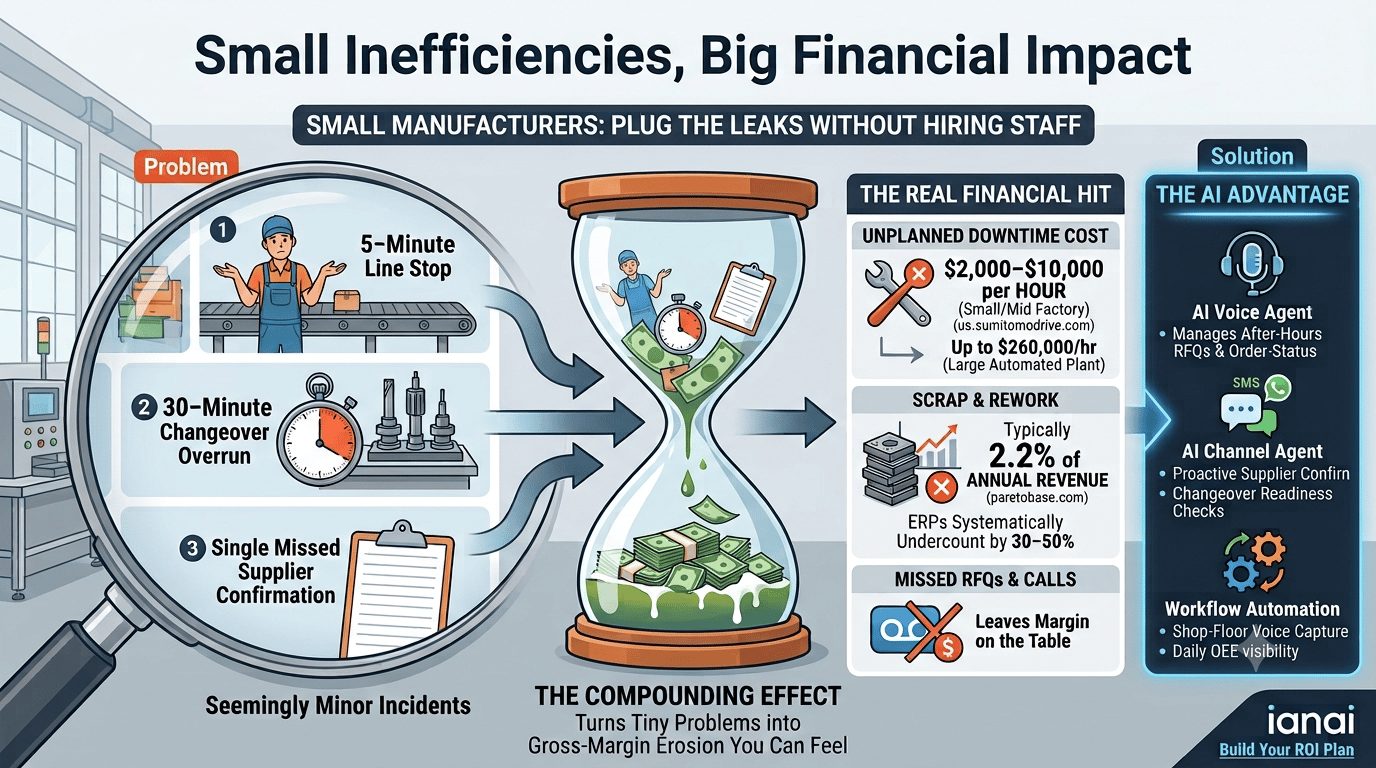
Small inefficiencies, big financial impact
A five‑minute line stop, a 30‑minute changeover overrun, a single missed supplier confirmation—none of these looks scary on their own. But in small manufacturing, the compounding effect turns tiny problems into gross‑margin erosion you can feel by quarter‑end. That’s because most small manufacturers run thin capacity buffers, have material as their largest cash outlay, and pay real money for every hour the shop isn’t shipping.
Consider three facts that set the stage:
- Small manufacturers make up roughly 98% of all U.S. manufacturing firms, so these “small” problems aren’t niche—they’re the norm for the backbone of the sector. (advocacy.sba.gov)
- Scrap and rework typically cost manufacturers around 2.2% of annual revenue, and many plants systematically undercount scrap by 30–50% due to how ERPs book setup and process waste. (paretobase.com)
- Unplanned downtime costs range widely: studies cite $260,000 per hour in large automated plants, but even in small/mid‑size factories, $2,000–$10,000 per hour is common once you include labor, lost margin, and expedite fees. (us.sumitomodrive.com)
When you add in schedule drift, long changeovers, and after‑hours RFQs that go to voicemail, seemingly minor inefficiencies become big financial hits.
---
Five “small” problems that quietly drain margin
1) Changeovers that run 20–40 minutes over
Every extra half‑hour spent changing tooling is a half‑hour you’re not making saleable product. In discrete and batch environments, SMED (Single‑Minute Exchange of Dies) routinely cuts changeovers 30–50%, and research shows setups can consume a shocking share of effective capacity if unmanaged. (sp.ftn.uns.ac.rs)
Example: A 2‑press cell runs three changeovers per shift. Each overrun averages 25 minutes. That’s 75 minutes lost per shift, 375 minutes per week—more than six production hours. If your contribution margin is $600 per machine‑hour, that overrun quietly burns ~$3,600 per week or ~$187,000 per year.
What turns this into a big financial problem: longer queues, bigger WIP piles, overtime to catch up, and eventually expedite freight to hit ship dates. Those costs rarely show up on one line item; they leak across COGS, overtime, and freight.
2) Scrap that “doesn’t look like much”
If you’re booking 3% scrap on $6M revenue, that’s $180,000 in material out the door—before you add labor and overhead tied up in bad units. Industry references put average scrap and rework around 2.2% of revenue, yet ERP‑captured scrap often excludes setup waste and hidden yield losses, understating the problem by 30–50%. (paretobase.com)
Example: A job that “only” loses two parts per shift at $35 material each across two shifts is $140/day in material. Add 15 minutes of touch time per unit at $22 loaded labor and you’re at $55/day in labor. Over 240 working days, that’s ~$46,000—and that’s just one SKU.
3) Supplier confirmations missed or late
One unconfirmed partial can cascade into a line stop. Even if you avoid a full stop, you’ll pay with resequencing, last‑minute trucking, and team time chasing status. Published ranges put unplanned downtime for smaller plants at $2,000–$10,000 per hour; a single hour saved per month is $24,000–$120,000 annualized. For context, “large plant” studies peg downtime at up to $260,000 per hour—different scale, same principle: time off the line is expensive. (innovapptive.com)
4) Schedule drift that steals capacity
OEE is useful, but world‑class “85%” targets come from the 1980s and can be misleading if you bury long changeovers in “planned” time. Modern benchmarks caution against copy‑pasting 85% and encourage looking at asset‑specific ranges—and keeping changeover reduction live as a metric, not swept into planned downtime. (oee-benchmark.org)
Why it matters: when OEE normalization hides changeover and short stops, you “hit the number” but still burn capacity. The cash impact shows up as overtime, longer lead times, and lost quotes due to extended promises.
5) After‑hours RFQs and customer calls that go to voicemail
If you miss one RFQ per week because no one answers at 7:15 p.m., and you close 25% at an average $9,000 order value with 22% contribution, that’s $49,500 in annual contribution margin left on the table. It feels like a sales problem, but operations created the conditions: thin office coverage and no structured intake for quotes and order‑status.
---
How these leaks show up on your P&L and cash flow
Operational inefficiencies rarely shout; they whisper in three places: COGS, SG&A, and working capital.
- COGS (material): Scrap and rework lift unit cost. A 1‑point swing in yield on a $6M plant with 45% material intensity is ~$27,000 in raw material alone.
- COGS (labor/overhead): Changeover overruns and short stops push labor into overhead with no shipped revenue. Even 20 minutes per shift adds ~87 hours/year per asset.
- SG&A: Sales and customer service triage absorb time chasing status across email, voicemail, and spreadsheets. That’s payroll that doesn’t create throughput.
- Working capital: Schedule slips grow WIP and finished‑goods days on hand. If your line of credit is at 8%, every extra $250,000 tied up is ~$20,000/year in interest and lost opportunity.
- Penalties and freight: Late‑delivery fees, expedite trucking, and premium freight skim margin. Spread across jobs, they hide in “freight out” rather than in your job costing.
The sum isn’t linear. Delays beget resequencing; resequencing begets more changeovers; more changeovers beget more mistakes—until cash is tight and you’re borrowing to make payroll.
If you’ve ever wondered why “we were so busy but didn’t make money,” it’s the compounding—small operational losses multiplying across days, jobs, and departments.
---
A one‑week diagnostic to find your biggest win
You don’t need a six‑month MES rollout to quantify where the money leaks. Run this practical, data‑light diagnostic next week.
- Day 1 (Monday): Time two changeovers end‑to‑end on your highest‑mix line. Note internal vs. external steps. Record any waiting on paperwork, tools, or approvals.
- Day 2 (Tuesday): Log all short stops >1 minute for one shift on a single machine. Tally cumulative minutes and the top three causes.
- Day 3 (Wednesday): Pull last 90 days of scrap by SKU. For each top‑10 SKU by margin, calculate scrap dollars (material + labor). Spot any “two bad parts per shift” offenders.
- Day 4 (Thursday): Export customer‑service tickets, voicemails, and after‑hours calls for 30 days. Count RFQs and order‑status inquiries missed outside office hours.
- Day 5 (Friday): Review supplier confirmations on the next two weeks of planned jobs. Flag any parts without confirmed delivery date + quantity.
- Weekend: Put the numbers into a quick model (below). Pick the one lever with the biggest 90‑day payback.
A simple calculator you can copy into a spreadsheet:
Cross‑check your scrap assumptions against industry references (2.2% of revenue is a reasonable starting point, but many plants undercount by 30–50%). Adjust your downtime dollars conservatively using a range that matches your factory scale. (paretobase.com)
---
Where AI voice and channel agents help small manufacturers
You don’t need a full new system to stop the bleeding; you need consistent execution on the boring, high‑leverage moments. That’s where AI voice agents for small businesses, channel agents (SMS, WhatsApp, web chat), and workflow automation earn their keep.
Here are targeted use cases that map directly to the leaks above:
- Changeover readiness checks (before the machine stops)
- 30 minutes before a scheduled changeover, an AI channel agent texts the cell lead a short checklist: next job, tooling, drawings, material lot, first‑article plan. If anything is missing, it opens a purchase‑req or kitting task automatically.
- Value: Converts internal steps to external work, the core SMED principle, cutting overruns without new hardware. (mdpi.com)
- Shop‑floor voice capture for scrap and short stops
- A hands‑free AI voice agent listens for “scrap two pieces on 10142 due to burrs” or “press 2 short stop, safety light misaligned,” logs it to your spreadsheet/ERP, and pings maintenance if a threshold is hit.
- Value: You get true scrap and micro‑stop data (not just what someone remembers), closing the 30–50% undercount that skews decisions. (symestic.com)
- Proactive supplier confirmations
- An AI agent reads POs, messages suppliers for ship dates, files confirmations, and escalates anything late. If a risk appears, it suggests resequencing to minimize additional changeovers.
- Value: Fewer line stops, fewer last‑minute expedites, and more predictable contribution per hour. (innovapptive.com)
- After‑hours RFQ and order‑status handling
- AI voice agents and web chat capture specifications, attach prints, answer standard questions, and book call‑backs for complex quotes. Order‑status bots pull live ERP milestones and text customers accurate ETAs.
- Value: Save the RFQs you used to miss and reduce daytime “where’s my order?” calls that bury your team.
- OEE visibility without chasing an outdated target
- Agents assemble a daily OEE‑lite report with availability, performance, quality, and an explicit “changeover variance” section so reductions stay visible instead of being normalized away.
- Value: Better decisions about sequencing and setups without worshiping a one‑size‑fits‑all 85% number. (oee-benchmark.org)
Behind the scenes, workflow automation ties these agents to your tools (ERP, CMMS, calendars, email/SMS). The goal isn’t fancy AI—just fewer leaks.
---
ROI math: a realistic 20‑person factory example
Let’s model a two‑shift, 20‑person fab shop doing $6.2M in annual revenue, 24% contribution margin after material (material intensity 48%), and three high‑mix cells.
Baseline assumptions (last 12 months):
- Changeovers: 4 per shift per cell, 18 minutes planned, actual 38 minutes on average (20‑minute overrun). That’s 80 extra minutes per shift across three cells.
- Scrap: 3.1% of revenue (ERP), mostly setup/startup and one stubborn SKU.
- Unplanned downtime: 3 hours/month per cell due to parts/material/maintenance overlap.
- After‑hours RFQs: ~4 per week missed.
Dollar impact today:
1) Changeover overruns
- Extra 80 minutes/shift × 2 shifts/day × 240 days = 640 hours/year of lost capacity.
- At $520 contribution per machine‑hour, that’s $332,800/year in contribution you never ship.
2) Scrap and rework
- 3.1% × $6.2M = $192,200 in top‑line material/rework loss.
- If ERP undercounts by even 25%, true loss could be ~$240,000. (paretobase.com)
3) Unplanned downtime
- 3 hr/mo/cell × 3 cells × 12 = 108 hours/year.
- Use $3,500/hour (midpoint for a small plant inclusive of labor, lost margin, expedites) ⇒ $378,000/year. (innovapptive.com)
4) Missed RFQs
- 4/week × 52 = 208 RFQs/year missed; 25% win rate; $8,500 avg order; 22% contribution ⇒ $97,240/year in contribution not captured.
Conservative total at risk: ~$1.05M/year.
Now apply practical fixes using AI agents and basic lean:
- SMED‑style readiness checks + kitting tasks reduce overrun minutes by 35% in 60 days.
- Voice capture for scrap + first‑article prompts cut scrap by 0.9 points (3.1% → 2.2%) across top SKUs.
- Supplier confirmation bot cuts unplanned parts‑related downtime by 40%.
- After‑hours RFQ agent answers calls/chats, collects specs, and books hot leads into next‑morning call blocks, reducing missed RFQs by 70%.
90‑day results annualized:
- Changeover savings: 35% × $332,800 ≈ $116,480.
- Scrap savings: 0.9% × $6.2M = $55,800 material; add $18,000 labor/overhead ⇒ ≈ $73,800.
- Downtime savings: 40% × $378,000 ≈ $151,200.
- RFQ recovery: 70% × $97,240 ≈ $68,068.
Total improvement ≈ $409,548/year. If your all‑in cost for agents and automation is $2,000/month ($24,000/year) plus a modest setup, the first‑year ROI is well over 10×, and payback is weeks, not quarters.
---
Implementation checklist (what to do this month)
1) Name one line owner for changeover readiness. Give them a 4‑item preflight the AI agent will text at T‑30 minutes before each swap. 2) Stand up shop‑floor voice capture. Start with two phrases: “scrap X on job Y reason Z” and “short stop on machine A reason B minutes C.” Route thresholds to maintenance. 3) Turn every PO into an automated supplier confirmation workflow. “Need by” dates, quantities, and a two‑step escalation path. 4) Put an AI voice agent on your main number after hours. It should collect RFQs (drawings, tolerances, material) and book next‑day callbacks into your estimator’s calendar. 5) Publish a one‑page daily report that shows: changeover variance minutes, scrap dollars by top SKUs, short‑stop minutes, and late supplier items.
None of this requires ripping out your ERP or buying a full MES. It requires closing the boring execution gaps that cost you real money.
---
Notes on benchmarks (so you don’t chase ghosts)
- Use OEE as a flashlight, not a religion. The “85% world‑class” mantra is a dated, asset‑specific heuristic—don’t let it hide changeovers in “planned time” where nobody improves them. (oee-benchmark.org)
- Expect SMED to deliver 30–50% setup reductions if you aggressively convert internal to external work and standardize. Results vary by mix and discipline, but the direction is consistent across case studies. (sp.ftn.uns.ac.rs)
- Price downtime realistically. If you’re a small shop, you won’t hit the $260k/hour headline—but $2k–$10k/hour is very plausible when you roll in margin, labor, and freight. Use your own numbers. (us.sumitomodrive.com)
- Scrap is almost always bigger than the ERP report suggests. Confirm by reconciling material issues, setup waste, and first‑pass yield logs. (symestic.com)
---
The bottom line: small problems compound. Tackle the handful that touch every job—changeovers, scrap visibility, supplier confirmations, and after‑hours intake—and your P&L will show it within a quarter. For small manufacturers, that’s the difference between “busy” and profitable.
Ready to plug these leaks without hiring more staff? ianai AI Employee gives you AI voice agents that answer the phone, channel agents that handle RFQs and order‑status in SMS and web chat, and workflow automation that chases suppliers and prepares changeovers—so your team ships more, with less stress. If you’d like help building a quick ROI plan based on your jobs and cells, we’d love to talk.