AI-Powered ERP: Intelligent Automation to Scale SMB Ops
Cut manual work and missed orders with AI-powered ERP capabilities that predict demand, automate approvals, and run cross-app workflows— so SMBs scale reliably.
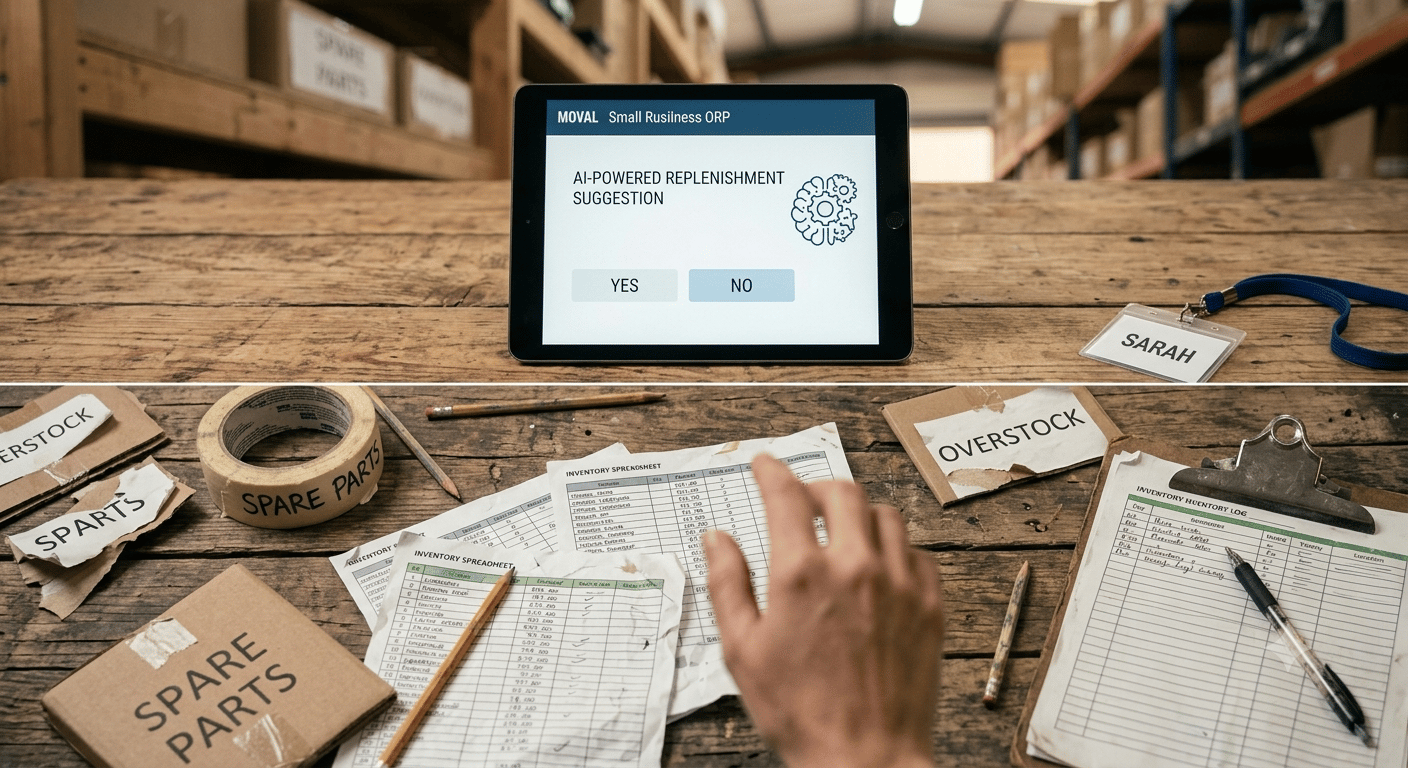
Companies with small IT teams still manage mission-critical operations through manual ERP processes, including spreadsheets for replenishment, phone calls to confirm approvals, and batch uploads to close the month. This manual approach consumes valuable time, increases the risk of errors, and obscures the root causes of late shipments and cash flow issues.
AI-powered ERP replaces repetitive manual tasks with intelligent automation that predicts business needs, executes actions across systems, and keeps humans involved whenever critical judgment is required. The result: fewer stockouts, faster order turnaround, and measurable hours saved each month. (businesswire.com)
What AI-Powered ERP Actually Means for SMBs
AI-powered ERP isn't just a predictive widget added to a dashboard. It combines three core capabilities that modern businesses should expect:
- Embedded predictive models that forecast demand, cash flow, and supplier risk using internal ERP data along with external signals, such as promotions, weather, and carrier delays.
- Autonomous workflows that trigger actions—such as creating purchase orders, escalating overdue invoices, or routing rush shipments—and automatically reconcile the results back into the ERP.
- Conversational and programmatic interfaces that allow non-technical staff and customers to interact with the ERP through voice, SMS, or chat without navigating complex screens. Major ERP vendors introduced these capabilities as part of their product roadmaps in 2024–2025, signaling a shift toward automation-first ERP. (oracle.com)
Put simply: AI‑powered ERP turns data into decisions and decisions into actions — without waiting for Monday’s review meeting.
Core Intelligent Automation Capabilities and Their Business Impact
Below are the most impactful AI capabilities in a modern ERP system and the business outcomes SMBs can expect when they implement them effectively.
1) Demand Forecasting That Reduces Stockouts and Excess Inventory
Traditional demand forecasting methods, such as seasonal trends and year-over-year growth, often fail to capture local market shifts. Modern machine learning (ML) models analyze point-of-sale (POS) data, promotions, returns, weather, and calendar events to significantly reduce forecast errors. Case studies show that forecast errors can decrease by 40–57% after deploying production-ready ML models. This improvement translates directly into fewer stockouts and reduced capital tied up in excess inventory.
For example, a retailer with $2 million in monthly inventory and a 35% mean absolute percentage error (MAPE) can recover millions in avoided stockouts and markdowns by improving forecast accuracy. (sofos.ai)
2) Autonomous Procure-to-Pay (P2P) and Order-to-Cash (O2C)
AI can automatically create purchase orders (POs) when predefined thresholds and forecast triggers are met, negotiate or select suppliers based on lead-time probability, and route invoices for approval when exceptions occur. On the receivables side, automated dunning messages, intelligent dispute classification, and AI-recommended payment plans help reduce days sales outstanding (DSO) while minimizing manual follow-up tasks.
Practical outcome: Automating routine P2P and O2C processes can save finance teams 10–30% of the time they spend on transactional work while accelerating cash conversion. Vendor announcements throughout 2024–2025 indicate that ERP providers are increasingly integrating these automated processes into their core modules. (oracle.com)
3) Anomaly Detection and Rapid Reconciliation
Instead of discovering reconciliation errors during month-end, AI detects inventory shrinkage, duplicate vendor invoices, and pricing or rate mismatches in near real time. The cost isn't just the error itself—it's the time required to identify and resolve it. Continuous anomaly monitoring reduces investigation time from days to hours, helping minimize financial losses, external liabilities, and late penalties.
4) Conversational Access and Role-Based Agents
When your receptionist, sales representative, or warehouse manager can ask ERP-related questions through voice or SMS and receive actionable responses — such as, “Is item X available for a same‑day ship?” — the entire organization can respond more efficiently.
These conversational interfaces are no longer experimental. Businesses are increasingly integrating voice and communication-channel AI agents that can read from and write to ERP records, enabling staff to resolve issues without navigating complex ERP screens.
Real SMB Scenarios: Numbers That Make the Business Case
Below are realistic scenarios that demonstrate the potential ROI businesses can achieve by implementing AI-powered ERP.
Scenario A — Local Retail Chain (10 Stores)
- Current: An average monthly inventory of $1.2 million and annual stock-related losses of $480,000 due to stockouts and markdowns.
- Intervention: Deploy machine learning (ML) demand forecasting combined with automated replenishment tied to ERP reorder points.
- Results (conservative): A 40% reduction in forecast error leads to a 30% reduction in stock-loss exposure, resulting in an estimated $144,000 annual improvement in gross margin. Vendor case studies report similar per-store improvements after production ML models are deployed. (sofos.ai)
Scenario B — Services SMB (Field Service, 25 Technicians)
- Current: Technicians lose 1 hour per day to administrative tasks, such as handling calls and manual scheduling, totaling approximately 25 hours per day across the team.
- Intervention: AI voice agents handle inbound emergency calls, check parts availability within the ERP, route dispatches, and automatically reschedule canceled appointments.
- Results: Recover 50% of administrative time, returning approximately 12.5 technician-hours per day. Assuming a billable rate of $80 per hour, that's roughly $325,000 in additional annual billable capacity. Vendor reports and market surveys show that SMBs save 20+ hours per month by adopting AI for customer-facing processes. (businesswire.com)
Scenario C — Wholesale Distributor
- Current: Manual approval processes result in a 48-hour order turnaround, while late shipments increase expedited freight costs and contribute to customer churn.
- Intervention: Implement automated credit checks, auto-approval for low-risk orders, and AI-powered priority routing to the warehouse.
- Results: Reduce order turnaround to same-day for 70% of orders, lowering expedited freight costs by 15–25% while improving repeat order rates. ERP vendors are increasingly providing APIs and workflow automation tools that enable these capabilities. (techtarget.com)
These scenarios are intentionally conservative. Broad market studies show that SMB adoption of AI surged throughout 2024–2025, with many business owners reporting measurable time savings and efficiency gains that align with the examples above. (businesswire.com)
Implementation Checklist: How to Deploy Intelligent Automation Without Disruption
Building a smarter ERP starts with reliable data and ends with a controlled rollout. Use the following checklist to guide your implementation:
- Build a clean foundation: Ensure your master data (items, SKUs, and vendors) is normalized and properly mapped. Automation amplifies both good and bad data, so poor-quality data can quickly lead to inaccurate results.
- Start with high-value, low-risk processes: Replenishment triggers, duplicate invoice detection, and customer status lookups are easier wins than automating complex processes such as credit policy decisions.
- Keep humans in the loop: Allow automation to recommend actions while requiring human approval for exceptions that exceed predefined thresholds.
- Measure and iterate: Track key metrics such as forecast MAPE, order-to-cash cycle time, DSO, and administrative hours saved. Review performance regularly and refine your models on a quarterly basis.
- Prioritize governance and security: Verify data flows, access controls, and audit trails—especially when handling financial data and personally identifiable information (PII).
- Budget for integration: many SMBs use hybrid Plan for integration costs: Many SMBs rely on hybrid technology stacks that include POS, payroll, and shipping systems. Budget for connectors, integrations, and ongoing monitoring. While vendors now offer more built-in connectors and prebuilt AI capabilities, integration complexity still varies.(techtarget.com)
A final practical tip: Many SMBs begin their AI adoption journey with freemium or low-cost solutions. Expect minimal upfront investment during the proof-of-value stage, then scale your implementation once the savings and business benefits have been validated. Market reports show that small businesses often start with affordable AI tools before investing in deeper ERP automation.(axios.com)
Where AI Voice and Channel Agents Meet ERP: An Operational Example
One of the biggest operational improvements for many SMBs comes from connecting conversational AI agents directly to ERP workflows. Here's an end-to-end example using an "AI Employee" model:
- A customer calls after business hours to check the status of a service appointment. The AI voice agent answers the call and authenticates the customer using their phone number and last order.
- The agent checks ERP inventory for the required part and confirms technician availability.
- If the required part or appointment slot is unavailable, the agent offers the next available option, automatically creates a reorder in the ERP if needed, and sends an SMS confirmation.
- If the request is high priority, the agent escalates it to a dispatcher, providing full context along with recommended actions.
Time-back calculation: Each call handled by the AI eliminates a 3–6 minute human interaction, along with the associated follow-up scheduling. At a volume of 200 calls per month, this translates to approximately 10–20 hours saved each month for the front desk and dispatch team while also reducing missed appointments that could otherwise result in lost revenue. Connecting voice and chat agents to an ERP system enables businesses to achieve measurable automation benefits and maximize the value of their ERP investment. (businesswire.com)
(For implementation best practices, see our how-to guides on AI voice agents for small businesses and AI-to-human handoffs.)
Risks, Guardrails, and Realistic Expectations
AI within an ERP system can deliver significant value, but poorly governed automation can also introduce new risks:
- Garbage in, garbage out: AI models are only as reliable as the historical data they are trained on. Poor-quality data and anomalies can lead to inaccurate predictions and biased decisions.
- Over-automation: Fully automated approvals for high-risk orders can increase the risk of fraud and financial exposure.
- Hidden integration costs: Integrating connectors, data mapping, and reconciliation logic often requires additional engineering time and ongoing maintenance.
You can mitigate these risks by starting with small, manageable use cases, tracking performance metrics, requiring human approvals for high-impact decisions, and maintaining high-quality data. Global and regional reports show that SMBs are adopting AI cautiously, often through phased rollouts with measurable milestones and regular evaluations. (oecd.org)
The Market Signal: Why You Should Act Now (and What It Costs)
Vendor announcements and market research indicate rapid investment in AI capabilities across ERP platforms—from vendor-built AI agents to prebuilt machine learning (ML) forecasting modules. Global enterprise IT spending is increasingly driven by AI initiatives, and ERP vendors are embedding automation directly into core workflows rather than offering it as standalone add-ons. This creates an opportunity to adopt AI gradually and optimize your data processes before implementation becomes more complex and costly. Delaying adoption often results in higher retrofit costs later. (techradar.com)
Cost considerations: Many SMBs begin with a single, focused automation initiative—such as demand forecasting or automated invoicing—using a per-site or per-module pricing model. Because many organizations start with low-cost or freemium solutions, the first 3–6 months of proof-of-value can require only a modest investment. Most vendors and industry studies report measurable time savings within the first one to three months of implementation. (axios.com)
Conclusion — A Practical Next Step for SMB Leaders
AI-powered ERP is not a futuristic add-on. It combines practical capabilities—such as demand forecasting, autonomous workflows, anomaly detection, and conversational access—that transform ERP from a record-keeping system into an operational intelligence platform. For SMBs operating with tight margins and the need for agility, the benefits are clear: fewer stockouts, improved cash flow, and more productive staff.
If your priorities include reducing manual ERP tasks, improving forecast accuracy, and giving employees simple, conversational ways to take action, consider connecting ianai AI Employee to your ERP. Start with a single high-value workflow, such as replenishment or order handling, measure improvements in hours saved and DSO over a 90-day period, and then scale automation across additional business processes.