Faster Decisions in Manufacturing: Real-Time Beats Perfect
Make more money by acting on real-time shop-floor data. See why fast, 80% decisions beat delayed perfection—and how AI agents cut decision lead time to minutes.
The minutes that make or break a shift
At 10:42 a.m., a CNC cell throws a thermal alarm. Everyone feels it: scrap is looming, a delivery window is shrinking, and the supervisor is waiting on “one more report” before deciding to pause or push.
Those 15 indecisive minutes are expensive. Typical unplanned downtime in manufacturing is often cited around $260,000 per hour—and large plants can see $1–5 million per hour—so the gap between a 2‑minute action and a 20‑minute delay is not theoretical; it’s the P&L. (us.sumitomodrive.com)
Meanwhile, the average plant runs far from world‑class efficiency—roughly ~60% OEE is common in discrete operations—so every minute of hesitation further erodes already‑tight availability, performance, and quality. (abelara.com)
The uncomfortable truth: in most factories, “better later” loses to “good now.” This article explains why speed wins, where it wins on the floor, and a concrete way to build a real‑time decision stack—powered by AI agents—that shortens the interval from signal to action.
Why “fast enough” beats “perfect later”
- The cost of delay compounds. Each minute of uncertainty increases WIP aging, changeover risk, and the chance of producing defects at scale. NIST’s 2025 review highlights that downtime is a meaningful slice of planned production time, underscoring how latent decisions quietly tax output. (tsapps.nist.gov)
- Decision cycle time beats raw accuracy in dynamic environments. The OODA loop (observe–orient–decide–act) shows organizations gain advantage by iterating decisions faster than problems evolve. On the floor, the team that diagnoses, decides, and acts in minutes prevents scrap and rework that slower—though more “precise”—teams still end up fixing. (en.wikipedia.org)
- Timeliness–accuracy frontier. New research on forecasting shows that predictors optimized purely for accuracy tend to lag turning points; when the world is changing, a slightly less precise but earlier signal can be more valuable than a perfect, late one. That’s exactly the frontier shop leaders face during quality spills, machine wear events, or supplier slips. (arxiv.org)
Perfection is a wonderful standard for machined tolerances; it’s a poor standard for the clock. The goal is bounded, fast decisions that you can rapidly revise as new data lands.
Where real-time decisions pay off on the shop floor
Below are concrete places where seconds and minutes matter more than an end‑of‑shift report.
1) Quality holds and release-to-run
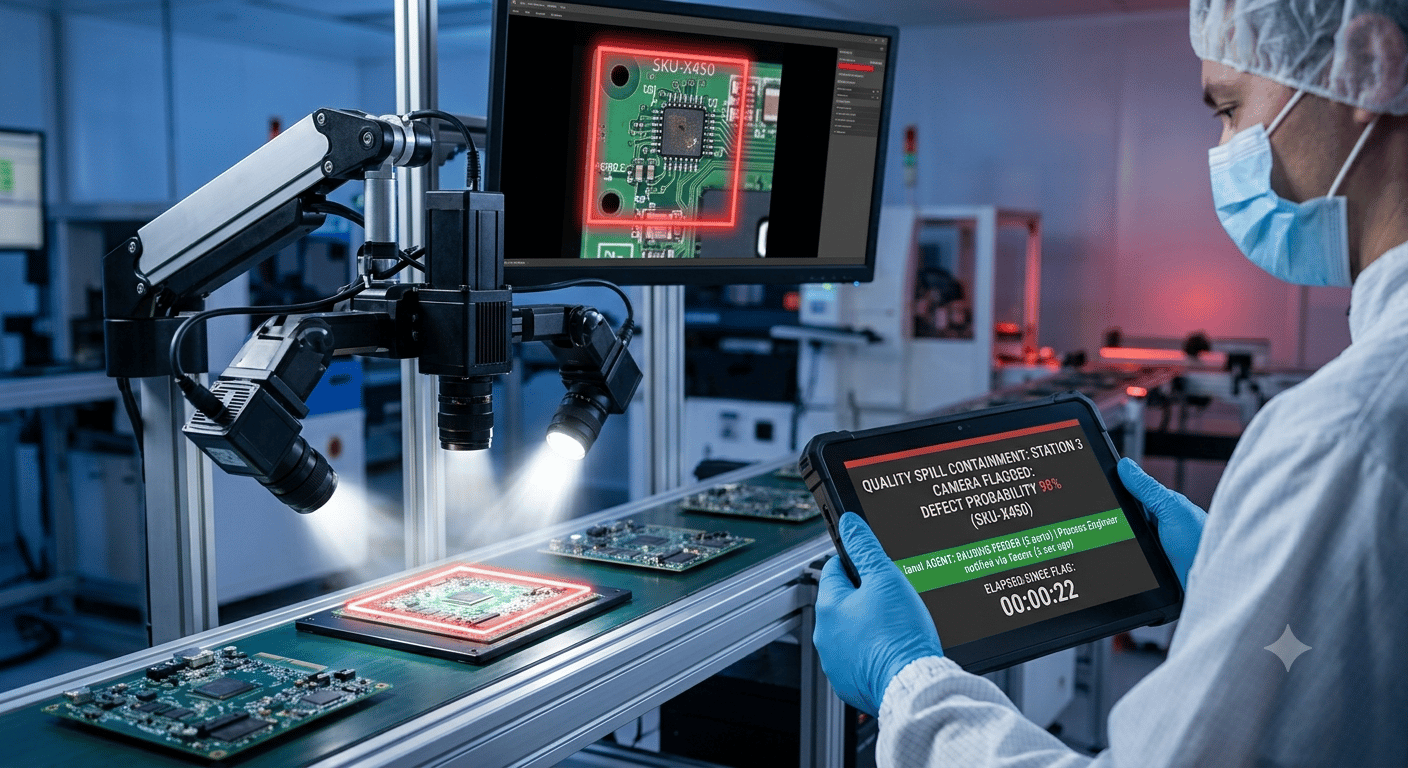
- Scenario: A camera flags a probable defect at Station 3. Waiting for a full QC analysis risks propagating defects downstream.
- Fast path: Pause the feeder, sample five parts, notify the process engineer immediately, and adjust a recipe parameter.
- Why speed wins: You stop defects at source (jidoka) and resume good flow sooner; an andon‑style immediate response was designed to do exactly this. (lean.org)
2) Maintenance triage on incipient faults
- Scenario: Vibration trends cross a soft threshold on a spindle.
- Fast path: Create a focused work order now, schedule a 12‑minute micro‑stop between orders, and change the bearing before it becomes a hard stop.
- Evidence base: Real‑time anomaly detection and edge data architectures (OPC UA + Kafka) have been validated to cut reaction times and enable actionable alerts. (sciencedirect.com)
3) Changeover readiness
- Scenario: Tooling arrives but the setup cart is half‑complete, and the crew is waiting on material verification.
- Fast path: Trigger a readiness checklist the moment the last good piece is counted; if any step is red, escalate to the cell lead with a timestamped blocker.
- Why speed wins: Cuts small stops and changeover drift that sap OEE availability. (abelara.com)
4) Customer ETA and promise dates
- Scenario: Sales needs an accurate promise date while capacity is shifting.
- Fast path: Use current queue, run rates, and WIP to quote a realistic window—then auto‑update if shop conditions change.
- Evidence base: Machine‑learning models improve lead‑time prediction accuracy by 30%+ vs. static plan times, which matters more when you quote early and adjust often. (journals.sagepub.com)
5) Supplier expedites and shortages
- Scenario: A resin shipment is 48 hours late.
- Fast path: Trigger substitution rules, re‑sequence affected orders, and proactively notify customers with revised windows.
- Why speed wins: Protects OTIF; world‑class delivery performance typically targets 95%+ OTIF, and proactive communication preserves goodwill. (metricgate.com)
Across all five, the pattern is the same: a fast, bounded move now beats a theoretically optimal move that arrives after the window to create value has closed.
A practical real‑time architecture for SMB manufacturers
You don’t need to rip and replace your stack. The fastest wins come from wiring up what you already own and adding a thin, event‑driven layer.
- Instrument the moment of truth
- Signals: PLC tags, sensor thresholds, machine states, scrap codes, WIP moves, and MES events.
- Transport: Standardize on an industrial namespace (OPC UA to an edge broker; Kafka or MQTT for publish/subscribe). Validated architectures show this combo supports fast, reliable dataflow from line to decision. (mdpi.com)
- Make data usable instantly
- Normalize events with context (line, order, SKU, shift) and compute rolling KPIs (SPC bands, cycle deltas) right at the edge to reduce cloud round trips.
- Use online KPI monitoring to surface anomalies while the batch is still running—not after first‑article inspection has finished. (sciencedirect.com)
- Connect to source‑of‑truth systems
- ERP/MES for routings, BOMs, and plan times; CMMS for work orders; WMS/TMS for material and shipments.
- Many factories already run analytics, cloud, and IIoT components—use them. A 2025 survey shows majority adoption of cloud and analytics, with nearly half using IIoT—solid foundations for real‑time decisions. (deloitte.com)
- Put decisions where people actually work
- Don’t bury alerts in dashboards. Deliver them to radios, SMS, WhatsApp, Teams, or a phone call. Generative AI is already helping manufacturers provide the right knowledge at the right time via conversational interfaces tied to real‑time data. (www2.deloitte.com)
- Measure “decision lead time”
- Track the interval from first abnormal signal to the committed action (e.g., “fault detected” → “feeder paused” or “WO created”). Shorten this first; OEE will follow.
A minimal schema for event‑to‑action
This is the backbone your AI agents will ride.
AI agents for manufacturing: patterns you can deploy now
ianai AI Employee combines AI voice agents, channel agents (SMS, chat, WhatsApp), and workflow automation. Here’s how those patterns shrink decision lead time without adding headcount.
1) Andon triage agent
- Trigger: Machine or operator raises an andon.
- What it does: Calls the right maintainer, collects three scoping answers (“noise? heat? last change?”), opens a CMMS work order with photos, and starts a 5‑minute SLA timer. If no human responds, it escalates to the on‑call supervisor.
- Why it matters: Reinforces jidoka by bringing help immediately to the problem, not after a report queues up. (lean.org)
2) Quality spill containment agent
- Trigger: SPC violation or camera defect probability > threshold.
- What it does: Pauses feeder for a defined sample window, texts the process engineer, pulls the current recipe from MES, suggests the most probable one‑click correction from past fixes, and documents the containment action in the lot record.
- Evidence: Real‑time anomaly frameworks demonstrate that online KPI monitoring materially improves reaction speed during production, not days later. (sciencedirect.com)
3) Order promise and ETA agent
- Trigger: New RFQ call or inbound web chat; customer asks “When can you deliver?”
- What it does: Reads run‑rate and queue from MES, applies learned lead‑time corrections, returns a promise window, and explains the basis (“current batch completes 14:20; setup 12 min; your lot would start 14:35”). If shop conditions change, it pro‑actively updates the promise.
- Why it matters: ML‑based lead‑time prediction is measurably more accurate than static plan times—so the earliest, data‑backed promise wins the PO and preserves OTIF. (journals.sagepub.com)
4) Supplier expedite agent
- Trigger: ASN delay or carrier exception.
- What it does: Calls the supplier for a revised ETA, checks alternates, suggests re‑sequencing in MES, and notifies affected customers with updated windows.
- Why it matters: Speed cushions supply volatility and protects downstream schedules. Deloitte and McKinsey both note that leaders are focusing AI on end‑to‑end visibility and faster cross‑functional decisions. (deloitte.com)
5) Shift‑handoff briefings
- Trigger: Ten minutes before shift change.
- What it does: Gathers top exceptions, blocked work orders, and late materials; produces a 90‑second voice briefing and a checklist for the incoming lead.
- Why it matters: Keeps the OODA loop tight across shift boundaries so momentum doesn’t die at 2:00 p.m. (en.wikipedia.org)
These are not futureware. Deloitte reports most manufacturers have already initiated AI pilots, with operators and managers using conversational interfaces to track production and inventory in real time—exactly where agents shine. (www2.deloitte.com)
Governance, metrics, and a 90‑day rollout plan
Speed must be safe. Here’s how to build confidence while you cut decision lead time.
- Guardrails for fast moves
- Define safe defaults: sample‑then‑resume, micro‑stop windows, and auto‑escalation after N minutes with no human ack.
- Require dual‑confirm for high‑impact actions (e.g., recipe changes) and log every intervention in ERP/MES.
- Start with read‑only integrations, then progress to write‑backs once operators and engineers trust the loop.
- What to measure weekly
- Decision Lead Time (DLT): signal → action time by category (quality, maintenance, material).
- Containment MTTR: event start → “back to rate.”
- Missed promises avoided: customer quotes updated before breach.
- OEE deltas: availability loss from small stops and changeovers pre/post agent.
- 30‑60‑90 day plan
- Days 0–30: Map one line’s top five exceptions and instrument signals (OPC UA/MQTT to an edge broker). Deliver alerts to radios/SMS; create read‑only workflows. (mdpi.com)
- Days 31–60: Deploy two agents (andon triage, quality spill). Enable limited write‑backs: open CMMS WOs; pause feeders for sample windows. Track DLT and MTTR.
- Days 61–90: Add an order‑promise agent for RFQs and a supplier‑expedite agent. Tie alerts to Teams/WhatsApp and a phone hotline. Publish a weekly scoreboard with DLT trends and avoided breaches.
- ROI math you can sanity‑check
- Suppose a line produces 40 units/hour at $85 contribution margin.
- If an andon triage agent cuts average decision time by 8 minutes on three events per shift, that’s 24 minutes of regained productive time—roughly 16 units/day or $1,360/day. Over 20 working days, that’s ~$27,200/month—before you count avoided scrap or late fees.
- This stacks with the broader reality that downtime is disproportionately costly in manufacturing; small reductions in delay time punch above their weight. (us.sumitomodrive.com)
What great looks like (and how to get there with ianai)
High‑velocity factories share three traits:
- Events become conversations in seconds. Alerts don’t sit in dashboards—they find the right human on the first try. (www2.deloitte.com)
- Policies are encoded. If X happens, do Y now, and escalate by Z. Engineers tune policies with data, not folklore.
- The loop is closed. Every signal → action → outcome is logged back to ERP/MES so the system—and the team—learns.
ianai AI Employee helps you get there fast:
- AI voice agents for small manufacturers that answer supplier and customer calls 24/7, give data‑backed ETAs, and escalate urgent exceptions to the floor lead.
- Channel agents that turn shop‑floor andon alerts into SMS, WhatsApp, or Teams messages—with a two‑way conversation to capture photos, notes, or counts.
- Manufacturing workflow automation that executes safe default actions (open work orders, trigger sample windows, re‑sequence jobs) and logs the paper trail.
The payoff is simple: shorter decision lead time, fewer defects that get downstream, and promises you can keep. McKinsey notes that leading plants increasingly embed AI into core make‑and‑deliver workflows, while many COOs still wrestle with data foundations—meaning the winners will be those who pair ambition with the plumbing that feeds real‑time action. (mckinsey.com)
Ready to move from “better later” to “good now”? Try ianai AI Employee to wire real‑time manufacturing data into fast, safe decisions—so your team spends less time waiting and more time making.